
Five Science Fiction Books That Shaped My Writing
By: Ginger on August 7, 2026




Every writer can point to a handful of books that permanently changed the way they think about storytelling. Sometimes it’s because of unforgettable characters or immersive world building. Other times it’s the ideas behind those stories that linger, especially when they continue to feel relevant decades later. Looking back at the novels that shaped your own writing can reveal as much about your creative voice as any writing course ever could.
This week, Ginger revisits the five science fiction novels that had the greatest impact on his own journey as a writer. Through each one, he explores not only why the story has endured, but also the fascinating history behind its creation and the ideas that have stayed with him ever since. His reflections are a reminder that every author has their own collection of books that helped shape the stories they tell today, often in ways they only come to recognize years later.
I wrote recently about the toughest lesson my father taught me about writing, and about how his lifelong love of science fiction, and the short story he never sent to the Daily Express, helped shape the writer I eventually became.
Since his passing, I’ve found myself thinking more and more about those bookshelves.
They were everywhere in our home growing up. My parents always believed that a good bookshelf made better decoration than wallpaper, so the walls of our houses were always lined with them. In the farmhouse we lived in near Exeter, one particular corridor was dominated by my father’s science fiction collection: paperbacks stacked two rows deep, spines facing out, and offering a whole universe of adventure to be explored.
I’ve written before about how science fiction uses the impossible to illuminate reality, and those bookshelves are a big part of why that idea resonates with me. Science fiction wasn’t just my father’s favorite genre, it was his window onto the world. He was a man who grew up during the war, came of age in the Space Age, and found in science fiction a literature that matched the speed and strangeness of his era.
I was never quite as passionate about science fiction as he was. I gravitated more toward the adventure novels he also introduced me to—Leslie Charteris, Jules Verne, Ian Fleming, and Clive Cussler. However, I still read his science fiction paperbacks eagerly too, and some of those books lodged in me at a level I’m still unpacking.
Here are the five I remember affecting me the most.
Dune — Frank Herbert (1965)
If my father’s shelves had a crown jewel, it was Dune.
Hopefully, you’ve seen the movie adaptations, because they’re good (even the 1980s adaptation was pretty good.) However, the books were on another level.
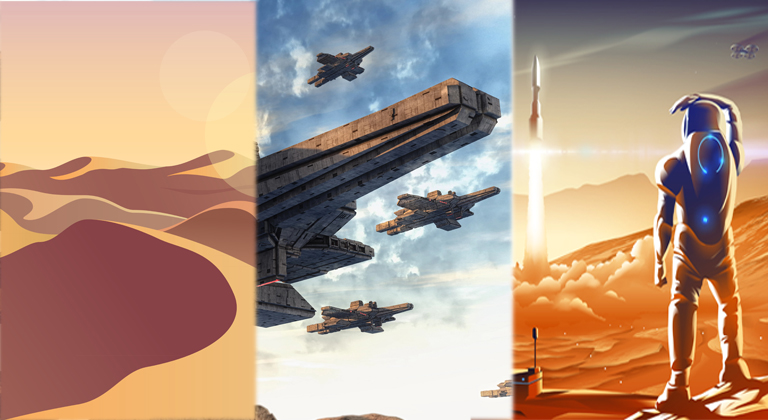
If you’re not familiar, Frank Herbert’s epic follows Paul Atreides, the young heir to a noble house, as his family is sent to govern Arrakis, a desert planet that’s also the sole source of the most valuable substance in the universe.
Betrayal, survival, prophecy, and the dangerous seduction of messianic power follow. It’s a novel of extraordinary scope; encompassing ecology, politics, religion, and destiny interwoven across an entirely imagined world, complete with its own history, languages, and philosophy.
Herbert came to the novel through journalism and an unlikely obsession with sand dunes, specifically the US Department of Agriculture’s project to stabilize the coastal dunes of Oregon. He became fascinated by how an entire ecosystem could pivot on a single resource, and began extrapolating outward. What he eventually produced was, in his own words, a “sand opera” that was also a meditation on the abuse of power and the dangers of hero worship.
Dune had been rejected by twenty publishers before finally landing at Chilton Books, a company ironically better known for automobile repair manuals. Initial sales were so poor that the editor who championed it was dismissed after just one year.
Yet Dune has since gone on to become iconic, translated into more than twenty languages and selling more than twenty million copies worldwide; more than any other science fiction novel in history. It won both the Hugo and the Nebula Awards in 1966 and has since never been out of print.
Why does it hold up? Because the story underneath the world-building is timeless. It’s about a young man who becomes exactly the kind of savior his people need, and exactly the kind of leader the galaxy should fear. Herbert was suspicious of heroes, and Dune is a novel about what happens when the hero wins. That ambivalence gives it a moral weight that most science fiction never reaches.
For those following the news in the Middle East, it’s also as prescient today as it ever was.
2001: A Space Odyssey — Arthur C. Clarke (1968)
Arthur C. Clarke occupies a unique place in the history of science fiction, he’s the only science fiction writer to have been nominated for the Nobel Peace Prize!
In 1945, he published a technical paper proposing a global communication network based on satellites in geostationary orbit, a concept that became the foundation of modern telecommunications. Clarke wasn’t merely imagining the future. He was, in several important instances, actually writing it.
And that’s true of 2001: A Space Odyssey, which began as a collaboration between Clarke and director Stanley Kubrick, developed simultaneously as a novel and a screenplay. As Kubrick focused increasingly on the film, the visions of the two men diverged, and the novel was largely written by and wholly attributed to Clarke. It opens with the prehistoric dawn of human intelligence—a sequence involving apes and a mysterious monolith that remains one of the most audacious beginnings in all of fiction—and ends with something genuinely difficult to put into words. In between, an astronaut makes a journey to Jupiter aboard a spacecraft controlled by an artificial intelligence called HAL 9000, which, by a terrible logic, concludes that its mission objectives require the elimination of its human crew.
(Just as Dune mirrors contemporary Middle Eastern geopolitics, 2001 mirrors our current fears about artificial intelligence!)
Ultimately, the novel is about the next step in human evolution, about what we might become if something beyond us decided we were ready. Clarke was a rationalist and an optimist, and 2001 reflects both. It’s a novel that believes in human potential even as it acknowledges human limitation.
Clarke received a knighthood from Queen Elizabeth II in 1998, and both an asteroid and a species of dinosaur have been named in his honour. The film version of 2001 remains one of the most influential ever made. However, the novel still stands alone—quieter than the film, and in some ways, much more unsettling.
Stranger in a Strange Land — Robert A. Heinlein (1961)
Heinlein is one of those writers who makes you think, sometimes against your will, sometimes against your better judgment, and almost always in ways you didn’t expect.
Stranger in a Strange Land tells the story of Valentine Michael Smith, a human born on Mars to the crew of the first expedition there, who grows up raised entirely by Martians. When he returns to Earth in his twenties, he’s simultaneously the most human person alive (biologically) and the least human (culturally). The novel follows his gradual, bewildered, and ultimately transformative encounter with human civilization—its religion, its politics, its sexuality, and its violence.
Heinlein wrote Stranger in a Strange Land deliberately to push boundaries and shock, with running themes of sexual freedom, individual liberty, and the influence of organized religion on human culture. The original manuscript ran to some 220,000 words, stretching the definition of the word “pocketbook.” The published version was cut by around 60,000, with passages considered too provocative for the audience of the time removed.
Even censored as it was, the book won the Hugo Award for Best Novel in 1962 and became the first science fiction novel to enter The New York Times bestseller list.
The novel also coined the word “grok”—meaning to understand something so completely that you become part of it—which passed into the wider culture and is still in use today (including by Elon Musk’s infamous generative AI tool!)
Starship Troopers — Robert A. Heinlein (1959)
My father liked Heinlein, so two of his books made it into this shortlist, and that demonstrates something that should tell you a lot about Heinlein’s range. Both Starship Troopers and Stranger in a Strange Land came from the same author, written just two years apart, but they couldn’t be more different!
Heinlein wrote Starship Troopers in reaction to a newspaper advertisement by a pacifist group calling on President Eisenhower to halt US nuclear weapons testing. Angered by what he saw as American cowardice, he abandoned the manuscript of Stranger in a Strange Land to write a militaristic response, a novel that would become one of the most debated in the history of the genre.
The story follows Juan “Johnny” Rico, a young man who enlists in the Mobile Infantry and fights a brutal interstellar war against an insectoid alien species. Much of the novel is less plot than argument, long passages on military duty, the nature of citizenship, the philosophy of violence, and what a society owes its defenders and vice versa. The society depicted requires military or federal service as a prerequisite for earning the right to vote.
Critics accused the novel of being fascist propaganda. However, it’s also been praised as the defining work of military science fiction, pioneering the concept of powered combat armour that has inspired countless works since.
The 1997 Paul Verhoeven film adaptation—which is, incidentally, one of my favorite movies—took a sharply satirical approach to the source material. In fact, it essentially made the opposite argument to the novel! However, whether you agree with Heinlein’s politics or not, you have to admit that Starship Troopers is a book that makes you argue with it, and that is a virtue, not a flaw. It deserved the Hugo Award it won for Best Novel in 1960.
Who Needs Men? — Edmund Cooper (1972)
…and then there’s this one.
Anybody who’s read any of my romance novels knows that they’re pretty freaky and out there (which readers seem to like!) It was books like this one that helped hone that voice.
Edmund Cooper was a British science fiction writer who produced a solid body of work through the 1960s and 70s. Who Needs Men?—published in the United States under the title Gender Genocide—is (depending on your tolerance) either the most fascinating or the most uncomfortable book on this list.
Set in the 25th century following large-scale biological warfare, the novel depicts the Republic of Anglia—in what was formerly England—as a scientifically advanced all-female state, where women reproduce through cloning and the last remaining men have been driven to the Highlands of Scotland, hunted as “regressives” slated for extermination.
The protagonist, Rura Alexandra, is sent to finish the job. Instead, she is captured, brutally “assaulted” by the men she was sent to destroy, and, in the novel’s most controversial turn (seriously, this is a slam-the-book-shut ewwwwwww! for many readers) gradually comes to embrace their world and their way of life.
There’s no getting around the fact that Who Needs Men? contains tropes that are, by any modern standard, deeply problematic. The notion of a woman being assaulted and subsequently “converting” to the values of her captors would be simply unacceptable in fiction today.
Cooper’s stated views on women make his intentions fairly transparent, he once remarked “let them compete against men, they’ll see that they can’t make it.” The SF Encyclopedia noted a “persistent edginess about women in power” throughout his later work.
However (or perhaps because) this book nevertheless has earned a readership, and some of those readers have been women, specifically women who found something in its darker scenarios that resonated with them in ways they found surprising.
For those of us who read from the modern “dark romance” genre—which has become one of the most commercially successful fiction categories of the past decade, dominated by female authors and female readers—this might not be as surprising as you’d imagine.
Dark romance frequently features precisely those scenarios of captivity, coercion, and unlikely transformation that make Who Needs Men? so uncomfortable. For better or worse, we have to accept that there’s something in the psychology of reading that allows us to engage with this kind of fictional darkness in ways that have no bearing on what we’d actually want or accept in real life. So, I’m not trying to provide justification for this novel’s problematic ideology, I’m just providing an honest observation about what stories can do.
I include Who Needs Men? on this list not because it’s good—although as problematic as it is, it is a well-written book—but because it’s a book that still generates arguments and shows up, almost inevitably, in the bookshelves of a certain generation of science fiction readers.
My father had a copy. Make of that what you will!
Conclusion
These five books don’t have much in common on the surface: an ecological space opera, a meditation on cosmic evolution, a countercultural thought experiment, a military philosophy lesson, and a deeply flawed dystopia. What they do share is the quality that defines the best science fiction. They all use an imagined world to say something true about the real one.
(And all of them are relevant to discussions we continue to have today.)
My father understood that. He read widely and he read carefully, and he passed both habits on to me. The romance novels I write don’t look much like the science fiction on those corridor shelves, but they grew from the same root, the conviction that stories matter, and that the ones worth telling are the ones that leave you thinking long after the last page.
Share this blog


Ginger is also known as Roland Hulme - a digital Don Draper with a Hemingway complex. Under a penname, he's sold 65,000+ copies of his romance novels, and reached more than 320,000 readers through Kindle Unlimited - using his background in marketing, advertising, and social media to reach an ever-expanding audience.