What “Obsession” Can Teach Authors About Story Structure
By: Ginger on October 23, 2026




Giving your character exactly what they want might sound like a happy ending, but what if doing so is the catalyst for all their troubles? In this week’s blog, Ginger takes a seasonal detour into horror by analyzing the surprise blockbuster Obsession, a movie whose unsettling premise offers useful lessons for authors across genres. Because beneath the scares lies a carefully constructed relationship between character, desire, and consequence that can help writers understand what makes a story compelling.
Ginger explores how the film builds tension by gradually exposing the truth behind its protagonist’s desires and questions whether anyone should be rooting for him. That growing gap between who we initially believe a character to be and what their choices reveal offers valuable insight into ways of connecting plot progression with character development. For authors writing any story in which a character’s wants collide with what they actually need, Obsession offers a fresh way to think about structure, motivation, and emotional payoff. Warning: This article includes major spoilers, so if you plan to watch the movie, save the article to read afterward.
It’s nearly Halloween, so I wanted to write a post that was appropriate to the season. However, full disclaimer, I don’t normally watch or read a ton of horror. Ever since I nearly walked out of the cinema after watching The Descent I’ve tried to stick to happier, more upbeat books and movies.
I’ll admit that upfront, because it makes what happened to me after watching the hottest horror movie of the year, Obsession, even stranger. I watched the credits roll thinking less about the gore (despite there being plenty of it) and more about plot structure. That’s not usually where my brain goes after choking on my popcorn for two hours.
But Obsession isn’t really a horror movie in the way we normally think of the term. There’s no Freddy or Jason. There are no zombies or ghosts. Instead, it’s a story about wanting the wrong thing for the wrong reasons and the sheer bloody horror of getting exactly what you asked for. It’s a breathtakingly terrifying movie and I’d also argue it’s one of the tightest pieces of narrative construction I’ve seen on screen in years.
It’s also a litmus test for human morality. I’ve had female friends break up with their partners because of the way they misread the movie (normally something like “Bear was a victim, too!”) and I honestly can’t blame them. This movie has such a lot to say about relationships and what makes it so terrifying is that doesn’t pull any punches when we get to the uncomfortable parts of the conversation.
That’s why, if you write romance or anything with an unreliable sense of “the protagonist getting what they deserve,” you need to see this movie, and then you need to steal from it! Let me explain why.
A Surprise Hit Nobody Saw Coming
Obsession is the feature debut of Curry Barker, a filmmaker who built his following making YouTube horror sketches before landing a deal with Blumhouse and Focus Features. The film stars Michael Johnston from Teen Wolf as Bear, a hapless, lovesick music store employee, and Inde Navarrette from Superman & Lois as Nikki, his longtime crush and closest friend, alongside Cooper Tomlinson, Megan Lawless, and Andy Richter rounding out the small, tightly wound cast.
The premise is simple: Bear can’t bring himself to tell Nikki how he feels, so in a moment of weakness he snaps a novelty item called a “One Wish Willow” and wishes that she’d love him more than anyone else in the world. The wish works. That’s the whole horror movie right there, a wish that works exactly as stated!
Critics loved it. It premiered in the Midnight section at the Toronto International Film Festival to raves and was picked up by Focus Features for a reported $14–15 million. Reviewers called it a clever, wickedly funny spin on the old “be careful what you wish for” fairy tale, anchored by two genuinely committed lead performances—Johnston nailing the slow curdle from sweet to sinister, and Navarrette doing something close to a two-hander with herself as “Nikki” and the possessed, obsessive version underneath.
The Budget-to-Box-Office Story Alone Is a Lesson
Money isn’t an accurate measure of merit, but it certainly says something. Obsession was made for somewhere between $750,000 and $1 million. It went on to gross well over $200 million worldwide, eventually becoming Focus Features’ highest-grossing release ever. That’s not a rounding error of overperformance, that’s a low-budget original horror film outgrossing its budget by roughly 200 times.
I bring this up not just because it’s a fun fact, but because it’s a reminder of something self-published authors should tattoo on their arms:
Budget doesn’t buy audience connection. Concept and execution do.
Nobody paid $200 million worth of ticket sales to see Obsession because of its unknown cast, subtle visual effects, or effective advertising. They paid because the story hit something true.
The Human Truths Underneath the Blood
That “something true” is worth pulling apart, because I think it’s the actual engine of why this movie works.
- Firstly, Bear isn’t actually the “nice guy” he’s presented as, and the movie knows it right from the start. We meet him as the protagonist, the guy we’re supposed to root for. He’s awkward, sweet, and hopelessly pining for Nikki. This makes him appear like a classic underdog romantic lead.
But the film slowly reveals the cracks. His cat dies because he was careless. His “friendship” with Nikki was never really friendship—it was a holding pattern, a means to an end. He doesn’t love Nikki. He doesn’t really even care about her. He just wants her, the way you want a thing you’ve decided you’re owed. That reveal is the movie’s real twist, and it lands specifically because we were set up in the beginning to trust him.
- Secondly, the horror here is a fear most men rarely have to sit with. Women are typically the ones fielding unwanted romantic intensity: being pursued, followed, fixated on. Obsession flips that axis and asks: What does it feel like to be the object of a devotion so total it erases the person underneath it?
In the story, Nikki doesn’t have any control over her actions. However, in real life, we’ve seen stories of what obsessed women can do and they make male stalkers look dull and unimaginative by comparison. There was Martha Marshall, who became known as the Audobon Society Stalker after she grew obsessed with a friend’s husband and then tormented them for years afterward, even poisoning their pets. Then there was Lisa Nowak, a former astronaut who wore adult diapers so she didn’t have to stop on her 950 mile chase to confront and threaten a romantic rival. Finally, when I first moved to New York in the early 2000s, I lived close to the town of Massapequa, where Amy Fisher—known as the “Long Island Lolita”—shot the wife of her married lover right through the head.
We generally think of men as the obsessive, threatening stalker types (and in defense, the statistics kind of support that.) However, when a woman becomes obsessed, she’s capable of much more sophistication in the terrifying lengths she’s willing to go to see her obsession through. It’s a genuinely underexplored fear, and putting a male protagonist inside it is part of what makes the film feel fresh instead of derivative.
Dan Harmon’s Story Circle, Told in Quadrants
Here’s the part that made me want to write this whole article. Obsession doesn’t just hit story beats, it moves cleanly through the four emotional quadrants of Dan Harmon’s story circle and in doing so maps out what makes a truly effective story.
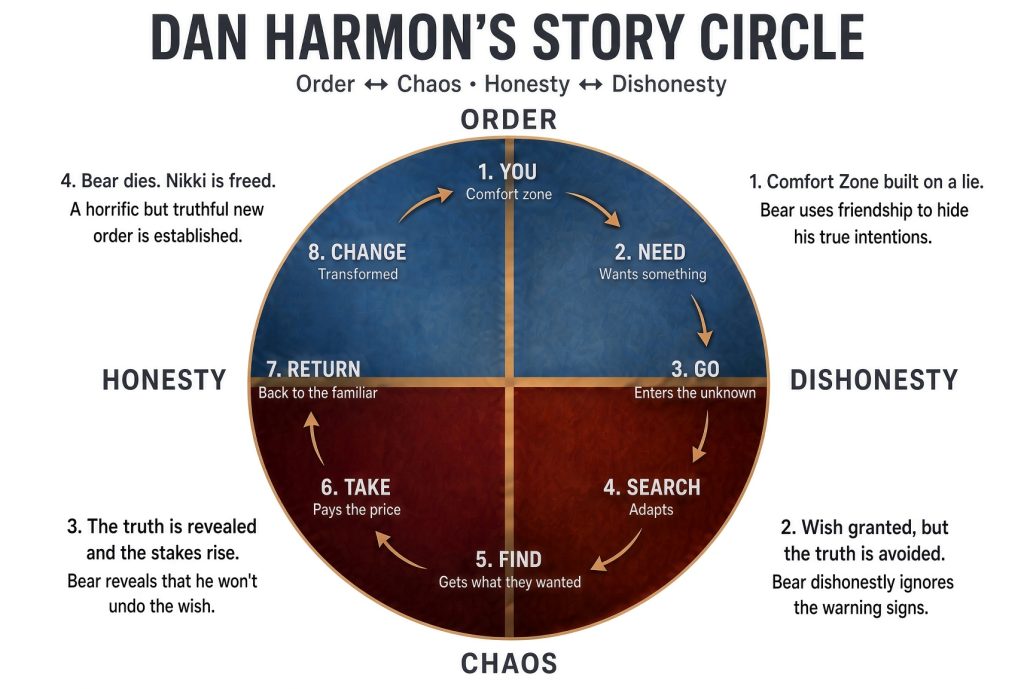
If you’re not familiar with Dan Harmon’s story circle you clearly don’t read many of my articles, because I won’t shut up about it. Normally we talk about the four story beats in the circle, but today we’re going to discuss the circle itself. As our protagonist moves through a story, he moves through four quadrants Dishonest Order >> Dishonest Chaos >> Honest Chaos >> Honest Order. They’re a perfect theme for what happens during each of the story beats that land within that quadrant. Let me explain using Obsession as the example.
- Dishonest Order. We open with an “order” that’s built on a lie. Bear is “just friends” with Nikki, except he isn’t. He wants more and is using the friendship dishonestly to try and get it. Nikki, for her part, is uncomfortable but doesn’t fully name it either. Nobody’s honest. Then Bear finds the One Wish Willow and uses it to get exactly what he claims he wanted.
- Dishonest Chaos. The wish “works,” but everyone involved is lying to themselves about what that means. Bear senses something is deeply wrong with Nikki when she suddenly claims to have feelings for him, but he pursues it anyway, because that’s what he’s always wanted. The real Nikki doesn’t want him—only “Freaky Nikki” does—and the film builds dread through small, wrong details that show how dishonest this attraction is. There’s her staring at Bear instead of watching TV when they’re cuddling together. There’s her unsettling stillness, as if she ceases to exist whenever Bear isn’t in her presence. It peaks at the scene in which Nikki, left alone too long, is found having vomited and soiled herself right where she stood. She’s become a woman so consumed by obsession that she can’t even take care of her most basic biological functions any longer. That isn’t love. It’s chaos—and it’s still dishonest, because nobody will say out loud what they actually see happening.
- Honest Chaos. The truth finally breaks through. Bear understands what the wish created, and Nikki’s danger becomes undeniable. But this is where the film reveals its real villain. It’s not the violence Nikki commits, but Bear’s response to it. Instead of trying to undo the wish and free her, he asks, “What’s so bad about being with me?” He tries to keep the monster that Nikki has become, because the monster is finally giving him what he wanted. That’s the most honest—and damning—moment in the film. Girl, this is why you need to dump your boyfriend if he argues that Bear “was also a victim.”
- Honest Order. Finally, Bear dies to free Nikki. As she returns to herself, we sit with the honest wreckage of what happened. No wish-fulfillment fantasy, no easy redemption, just consequence. It’s one of the starkest and darkest endings of any horror movie I’ve ever seen, and it was brilliant because of it.
I don’t think there’s a better example of how effective the four quadrants of a story circle can be than the script of Obsession. It isn’t just a gory date-night surprise. It’s a masterclass in what happens when structure and character psychology are locked in together right from page one.
Or, at least, that’s what I think. Have you seen Obsession? I’d love to hear what you thought of Bear as a protagonist. Did you catch the “nice guy” reveal coming, or did it sneak up on you the way it did me? Drop a comment below and let me know your thoughts!
Share this blog


Ginger is also known as Roland Hulme - a digital Don Draper with a Hemingway complex. Under a penname, he's sold 65,000+ copies of his romance novels, and reached more than 320,000 readers through Kindle Unlimited - using his background in marketing, advertising, and social media to reach an ever-expanding audience.