
What Backrooms Teaches Authors About Storytelling
By: Ginger on July 10, 2026




Every writer has experienced a book, movie, or TV show that lingers in their mind long after it’s over, not because of a clever plot twist or unforgettable ending, but because of the way it made them feel. That kind of emotional atmosphere can be difficult to create, yet when it’s done well it becomes one of the most powerful storytelling tools an author has. The creepy concept of the “Backrooms” has bounced around the internet for the last few years, with a recent YouTube series gaining so much traction that the teenager behind it was offered the chance to turn it into a movie. The film became a surprise hit, thanks to its unsettling sense of mystery that captivated audiences, even those who had never heard of the concept before.
This week, Ginger explores the reasons the movie has become such a success so that we might be able to apply similar techniques to our own work. As he discovered, rather than relying on constant exposition or neatly answering every question, Backrooms succeeds by trusting its audience and committing fully to the mood at the heart of its story. Revealing only parts of character backstories, prioritizing atmosphere alongside plot, and leaving the right kinds of questions unanswered are all techniques used to create a richer experience for readers. Whether you’re writing a standalone novel or building a long-running series, storytelling choices like these can help your books leave a lasting impression long after readers turn the final page.
One of the ways in which I bond with my kids is by watching the stuff they watch (which means I know far more about anime than most blokes my age.) It’s actually been really educational for me, and inspired a few articles like this one.
However, they don’t only watch anime, and I didn’t know what I was getting into when my eldest teenager sat me down to watch a series of YouTube videos he’d recently become obsessed with, published by a creator called Kane Pixels.
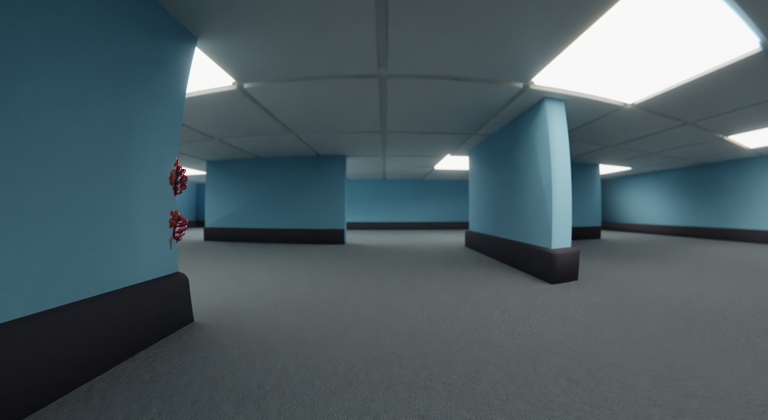
The videos—short, found-footage style clips depicting a liminal, fluorescent-lit labyrinth of empty office corridors that stretches into infinite nowhere—were deeply unsettling in a way I found difficult to articulate.
The concept is called the “Backrooms” and it originated as a simple internet creepypasta—the idea of “noclipping” out of the real world and finding yourself alone in a vast, buzzing, carpet-smelling void. Kane Pixels took that seed of an idea and grew something genuinely haunting from it.
It was so haunting, in fact, that horror movie production company A24 helped facilitate a full-length feature film about the Backrooms, directed by Kane Parsons himself (which is one hell of an achievement given that Kane is still a teenager!)
My kids and I were incredibly excited when we heard about the movie, and after sitting down to watch it, we didn’t leave the theater disappointed.
What struck me most was how you didn’t need to know anything about the Backrooms mythology to enjoy the film. It worked perfectly well as a standalone piece of unsettling, atmospheric cinema.
But if you did know the lore—if you’d spent time in those YouTube rabbit holes and understood the layers of internet mythology being referenced—the experience became something richer and more rewarding.
The film rewarded prior knowledge without ever demanding it. That is a harder trick to pull off than it sounds (as a lot of recent Marvel movies have proven, forcing you to “do homework” by watching the interconnected shows on Disney+ first.)
Backrooms, the movie, also reminded me of something I wrote about recently in this article on the power of vibe in storytelling, that the most compelling stories often succeed not because of their plot architecture, but because of the distinct emotional frequency they transmit.
That’s so true with the Backrooms movie, which is, more than almost anything else, a vibe. And it prioritizes that vibe over a conventional narrative structure. There is no clean three-act story circle here. There is mood, dread, atmosphere, and the creeping sense that the world you are looking at has rules you’ll never fully understand.
For self-published authors, there is a great deal to learn from how that choice was made, and how it paid off.
The Iceberg Beneath the Surface
Ernest Hemingway described what he called the “iceberg theory” of writing, which was the idea that the dignity and power of a story comes from what is not said. The writer knows the full depth of the submerged truth, and that knowledge gives weight and texture to the surface. The reader senses the mass below even if they never see it directly.
Backrooms applies this principle with considerable skill, particularly in how it handles its two central characters, Clark and Mary.
We learn almost nothing about Mary’s backstory through direct exposition. We’re not sat down and told that she grew up in a hoarder’s home, and we just get one scene showing how her mother was eventually committed. But we feel it. It’s in the way she moves through the cluttered, labyrinthine spaces of the Backrooms. Not with the panic of someone encountering disorder for the first time, but with a kind of exhausted familiarity. It’s in small behavioral details, in the way she organizes what little she has, in flashes of expression that suggest this particular kind of suffocating, inescapable environment is not entirely new to her.
The film shows us the iceberg’s tip and trusts us to feel the weight of the rest. It never tells. It never explains. And because of that restraint, Mary’s character carries an emotional gravity that a screenplay full of backstory monologues could never achieve.
This is the lesson for authors. Your characters’ histories do not need to be delivered to the reader. They need to be inhabited. When you know who your character is at their deepest level—what shaped them, what broke them, and what they’re compensating for—that knowledge bleeds into every choice they make, every line they speak, and every room they enter.
The reader feels it without being told. The iceberg floats because of the ice beneath the waterline. As an author, you don’t need to write the whole iceberg. You only need to show the tip and smart readers will figure out the rest.
Vibe as Narrative Architecture
Traditional story structure (whether that’s the hero’s journey, the story circle, or the three-act model) exists for excellent reasons. It works. In fact, it’s worked across centuries of human storytelling because it maps onto something real in how we process experience and meaning. Most of the time, as a self-published author, you should absolutely be using it.
But the Backrooms movie makes a compelling case that there are stories where atmosphere is the architecture. Where the emotional texture of the world you have created is so strong and so coherent that the conventional demand for escalating plot can be loosened in its favor.
Backrooms succeeds because the concept itself carries an almost primal resonance: the fluorescent hum, the endless identical corridors, the sense of being utterly alone in a space that was built for people but contains none.
It taps into something universal. That nightmare logic of being lost, the terror of the mundane rendered infinite, the specific dread of liminal spaces that feel like they’re between somewhere and nowhere. That vibe is what audiences came for, and the film delivers it without apology.
As an author, this should prompt a question. What is the core feeling at the heart of your story?
Not the plot. The feeling. Some stories are, at their marrow, about dread. Others are about longing, or belonging, or the particular warmth of coming home. If you can identify that frequency and commit to it fully—letting it infuse your prose, your settings, your character dynamics—your story will resonate with readers even when the conventional machinery of plot is less than perfect.
“It Left Me With More Questions Than Answers”
After the credits rolled, the young woman who’d come to see the film with us turned to me and said exactly that: “It left me with more questions than answers.” She didn’t say it with frustration. She said it the way you might remark on a dream that stays with you, with a kind of unsettled wonder.
In most storytelling contexts, “more questions than answers” is a failure. Readers and audiences come for resolution. They invest emotional energy in a narrative and expect, in return, the satisfaction of things being made clear. When a story withholds that, it can feel like a contract has been broken.
And yet, in the context of Backrooms, it worked. And this was largely because the questions themselves were part of the experience. The mythology of the Backrooms, both in the film and in the wider internet culture surrounding it, is built on incompleteness. The terror of it is precisely that nobody fully understands the rules. The film honoring that incompleteness was, paradoxically, a form of fidelity to its own story.
This is a narrow path, and as an author you should walk it carefully. The lesson is not “leave your readers confused and call it atmosphere.” The lesson is more nuanced than that. Certain kinds of stories are made more powerful by strategic incompleteness. When the unanswered questions feel intentional—when they deepen the world rather than suggesting the author simply didn’t know the answer—readers will accept them. Even embrace them.
The key is that the emotional journey must be satisfying even if the narrative one is not fully resolved. Your readers need to feel something has been completed within them, even if every thread in the plot hasn’t been tied off.
The Business Case for Leaving Doors Open
There’s also a very practical, commercial reason to think about what you leave unresolved, and Backrooms provides a striking illustration of it.
The film was made on a budget of approximately $10 million. It opened to $118 million at the worldwide box office in its debut weekend alone, a return that made industry observers’ jaws drop. It also set a new opening record for A24, and instantly established 20-year-old director Kane Parsons as one of the most exciting new voices in cinema. Sequels are now not just possible, they’re all but inevitable.
That outcome was enabled, in part, by the deliberate openness of the story. The Backrooms mythology is vast. The film explores one corner of it and leaves the rest humming in the dark. There are characters whose stories feel unfinished, rules of the world that feel barely sketched, and entire wings of the mythology that were never opened. However, that isn’t narrative sloppiness. It’s franchise architecture.
As a self-published author, you should absolutely ensure that each of your books has a satisfying conclusion. Your readers deserve that. A book that simply stops without delivering emotional resolution is a book that earns bad reviews and loses readers.
But there’s a significant difference between a satisfying conclusion and a complete one. Your protagonist’s immediate story can be resolved—the central conflict answered, the emotional arc completed—while larger questions about the world, about secondary characters, about the forces at work in your fictional universe, remain open.
Those open doors are invitations. They tell readers that the world doesn’t end when the book does. They create the appetite for sequels, for spin-offs, and for companion novels. They’re the narrative equivalent of a long corridor stretching off into the dark, a light at the far end, and the hum of something you can’t quite name buzzing in the distance.
Backrooms taught a generation of young moviegoers that stories don’t have to explain everything to be extraordinary. For self-published authors building a series, that’s a lesson worth writing on the wall above your desk.
The Vibe Is the Thing
What connects all of these lessons—the iceberg method, the atmosphere-as-structure, and the world-building that invites return—is that they all serve the same master.
The vibe.
Backrooms works because Kane Parsons committed, absolutely and without apology, to the feeling at the core of the concept. He didn’t sand it smooth for a wider audience. He didn’t explain away the mystery to make it more comfortable. He held the note, and it resonated.
Your job as a self-published author is the same. Know the feeling at the heart of your story, then protect it and build toward it in every scene.
Trust your readers to feel it even when you don’t spell it out, and when you leave those corridors open at the end (those unanswered questions and unlit rooms) make sure they hum with the same frequency as everything else.
That hum is what readers come back for.
Or, at least, that’s my opinion. What do you think?
Have you seen Backrooms yet? If you have, I’d love to hear your thoughts about it, and whether you went in cold or came in deep with the YouTube mythology.
And more broadly, what other stories, films, or pieces of fiction have given you that particular brand of compelling, creepy vibe? The kind that lingers and unsettles and (if you’re a writer) makes you want to understand how it was done? Let me know in the comments section!
Share this blog


Ginger is also known as Roland Hulme - a digital Don Draper with a Hemingway complex. Under a penname, he's sold 65,000+ copies of his romance novels, and reached more than 320,000 readers through Kindle Unlimited - using his background in marketing, advertising, and social media to reach an ever-expanding audience.